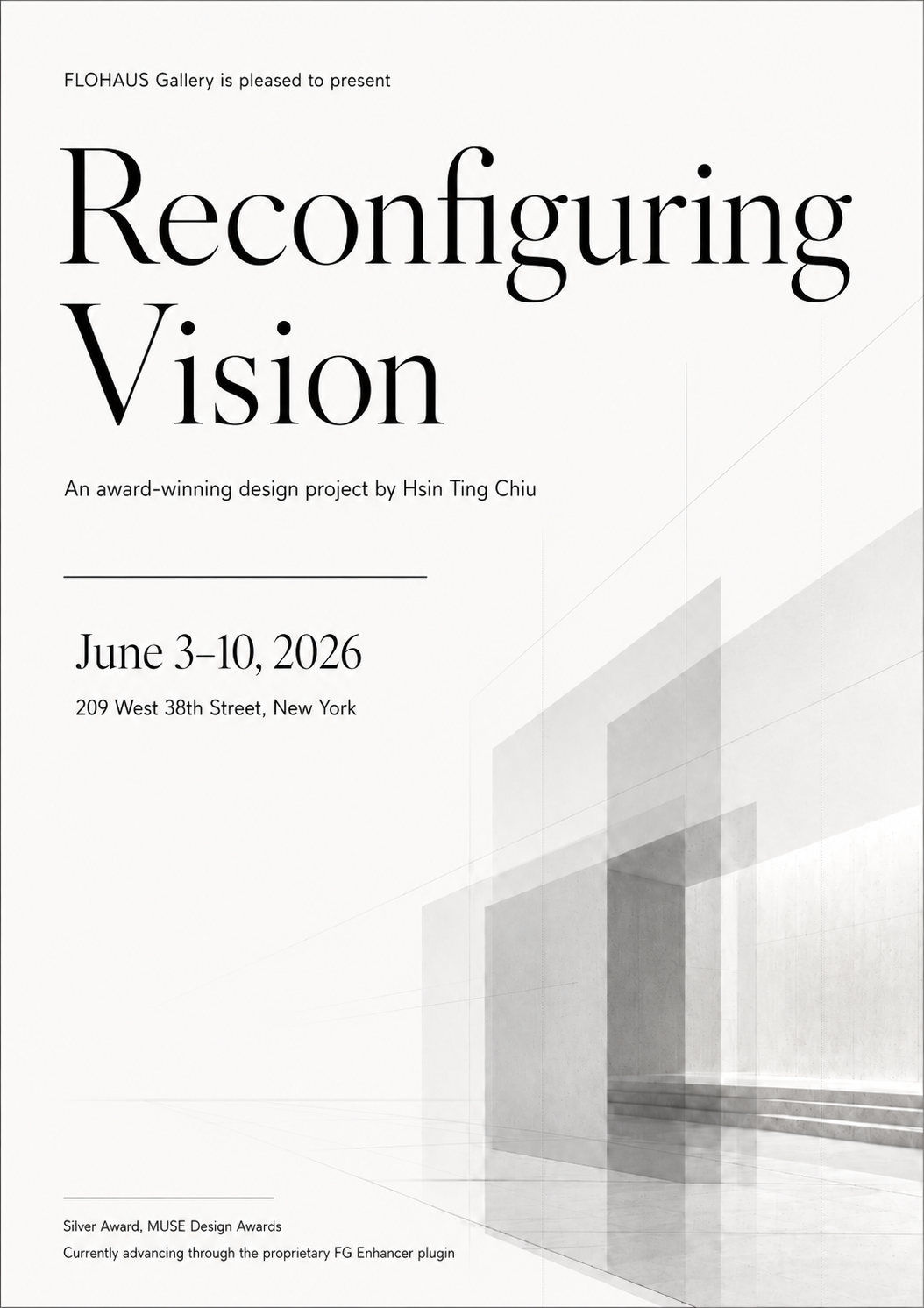
FLOHAUS Gallery is pleased to present Reconfiguring Vision, an award-winning design project by Hsin Ting Chiu, on view June 3 - 10, 2026.
This exhibition explores the relationship between memory, space, and visualization through a design system developed for the building materials retail industry. Rather than approaching design as a purely aesthetic practice, Hsin Ting Chiu examines how visual tools can shape the way people understand, imagine, and make decisions about physical environments.
Responding to the limitations of traditional visualization methods—particularly their lack of accuracy, flexibility, and practical reference value—the project proposes an innovative approach of “reconfiguring existing tools.” By using SketchUp as the backend and D5 Render as the visual core, Chiu establishes a workflow that transforms rendering technology into a powerful commercial visualizer. The system allows building materials to be presented through precise, efficient, and immersive 3D environments, helping customers better connect abstract product choices with real spatial possibilities.
Through this process, the project reflects on how space is not only built, but also imagined, remembered, and reconstructed through visual experience. The rendered environment becomes a bridge between material, memory, and future use, allowing viewers and consumers to envision how design decisions may enter everyday life.
With its high efficiency, low cost, and strong accuracy, the system reduces training time for new talent to just three days while improving customer decision-making speed and increasing average transaction value. Recognized with a Silver Award at the MUSE Design Awards, the project is now moving toward further automation and systemization through the development of the proprietary “FG Enhancer” plugin.
At FLOHAUS Gallery, this presentation considers how design systems can extend beyond commercial function to become a new language of spatial imagination—one that connects technology, material culture, and the evolving ways we experience built environments.