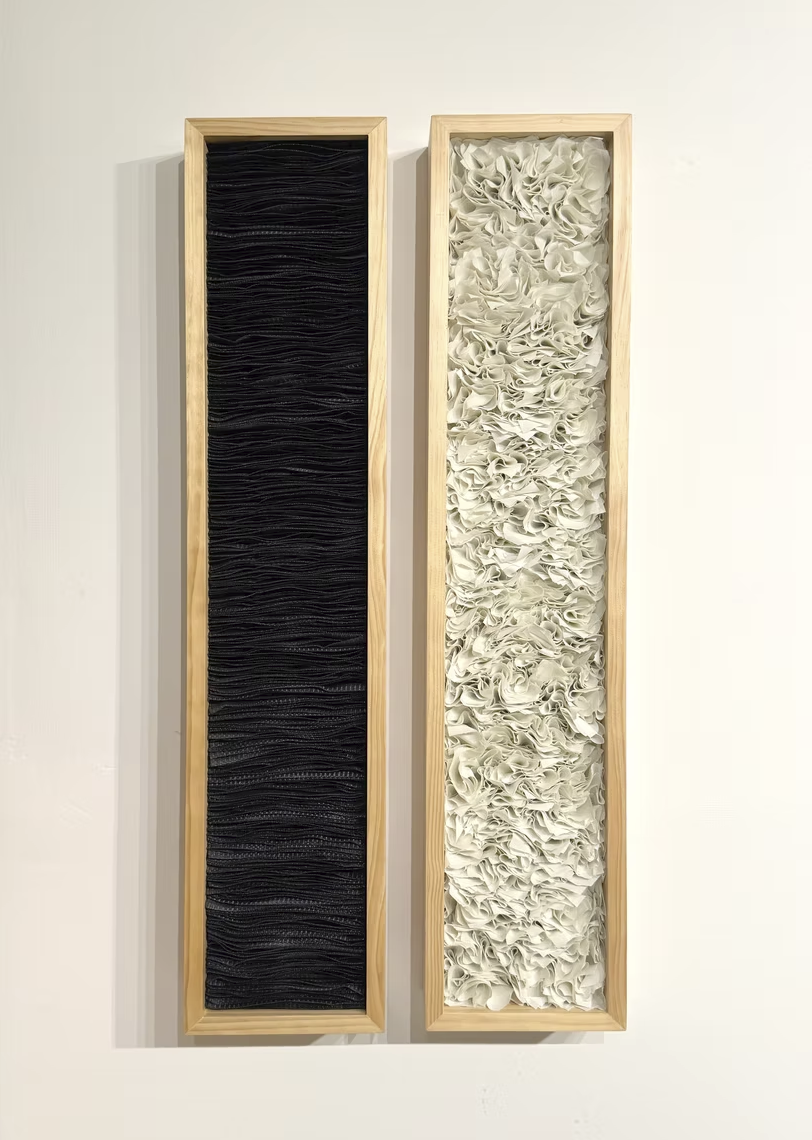
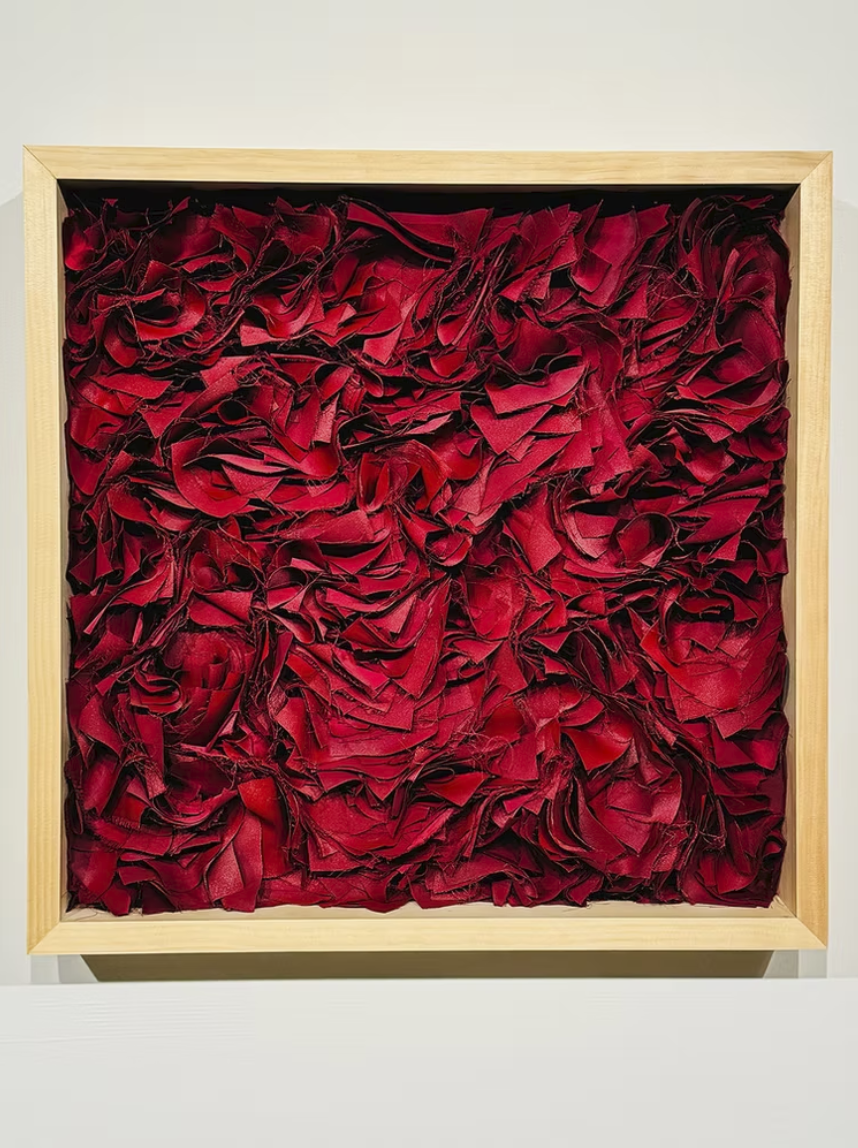
Natalie Dunham
Natalie Dunham earned her BFA in painting from Birmingham-Southern College (2007) and her MFA in sculpture from the Maryland Institute College of Art (2010). Her work has been exhibited internationally and is included in both public and private collections. She is currently based in the United States, with an additional workspace in Europe.
Dunham’s practice focuses on three-dimensional material studies, exploring geometric forms through accumulation. Her process emphasizes patience, precision, and intentionality, with each work assigned a numerical title that documents her evolving artistic journey. Working with texture, color, and form, she balances the raw qualities of materials with careful refinement. Through repetitive and meditative processes, her work creates a counterpoint to fast-paced contemporary culture, inviting viewers to slow down and engage more deeply with form, materiality, and time.
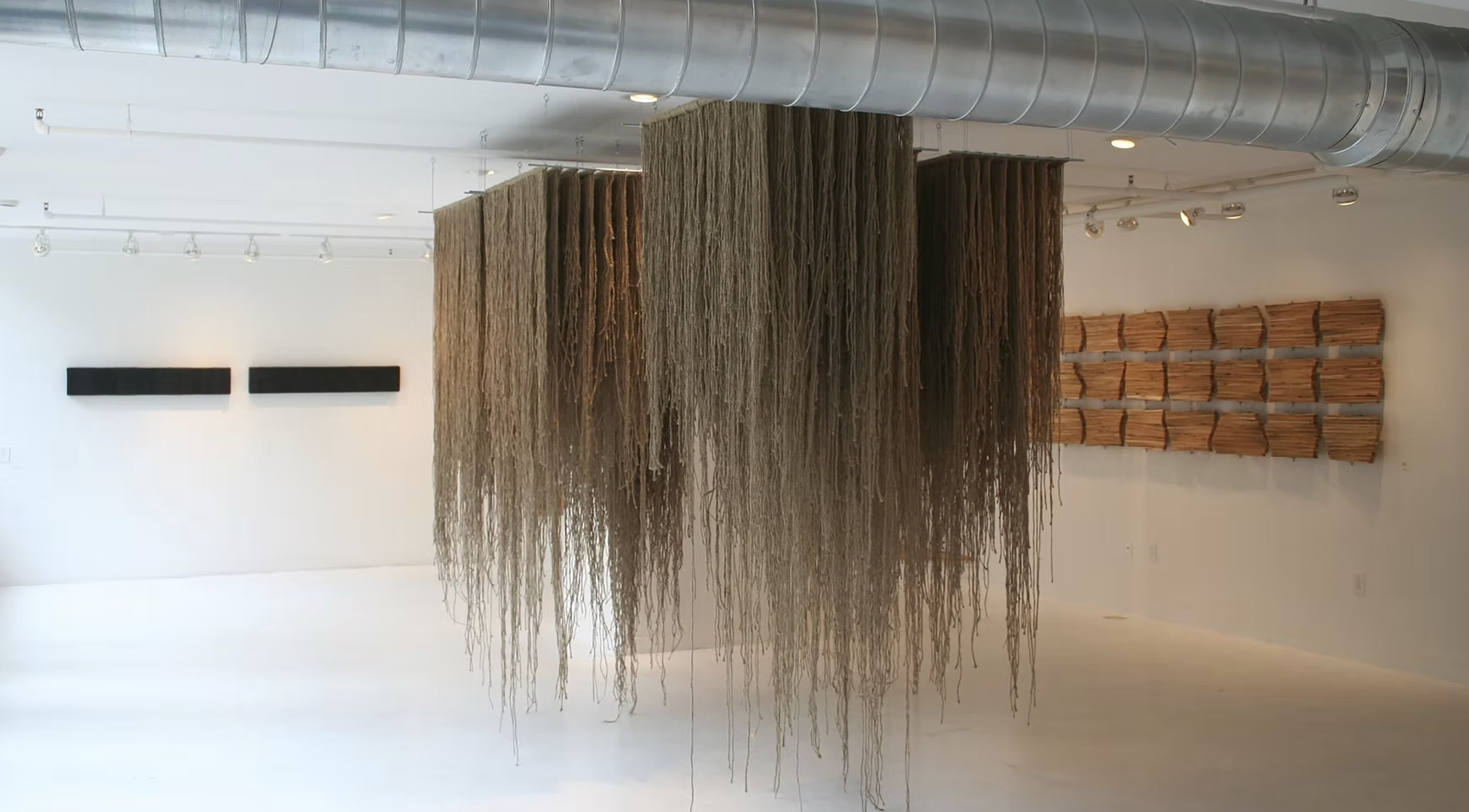
Q: To begin, could you briefly introduce yourself and your practice?
N: My name is Natalie Dunham. I am a process-based sculptor and installation artist. My work serves as a broader commentary on existence as a cumulative, rather than a finite, state of being. In a culture that often views life as a series of disconnected, high-speed 'results,' my practice asserts that existence lies in the integrity of the incremental.
By assigning numerical titles to my studies, I am documenting a chronological ledger of survival and evolution. This suggests that no moment of our lives is truly finished or discarded; instead, we are a layered record of every humble beginning and every refined decision we have made. The tension between the rawness of the material and the refinement of my shaping mirrors the human condition—the constant dialogue between our natural, inherited origins and our deliberate, mindful intentions.
Ultimately, I see existence as a search for order within complexity. Through the repetitive accumulation of simple geometric forms, I aim to create a contemplative space that invites the viewer to slow down. My art argues that to truly 'exist' in the modern world is a radical act of presence—a commitment to finding beauty in the subtle nuances of process and the stillness of introspection.
Q: Your works convey a strong sense of rhythm and movement through their rigid materials. What ideas about motion or flow were guiding you while shaping these forms?
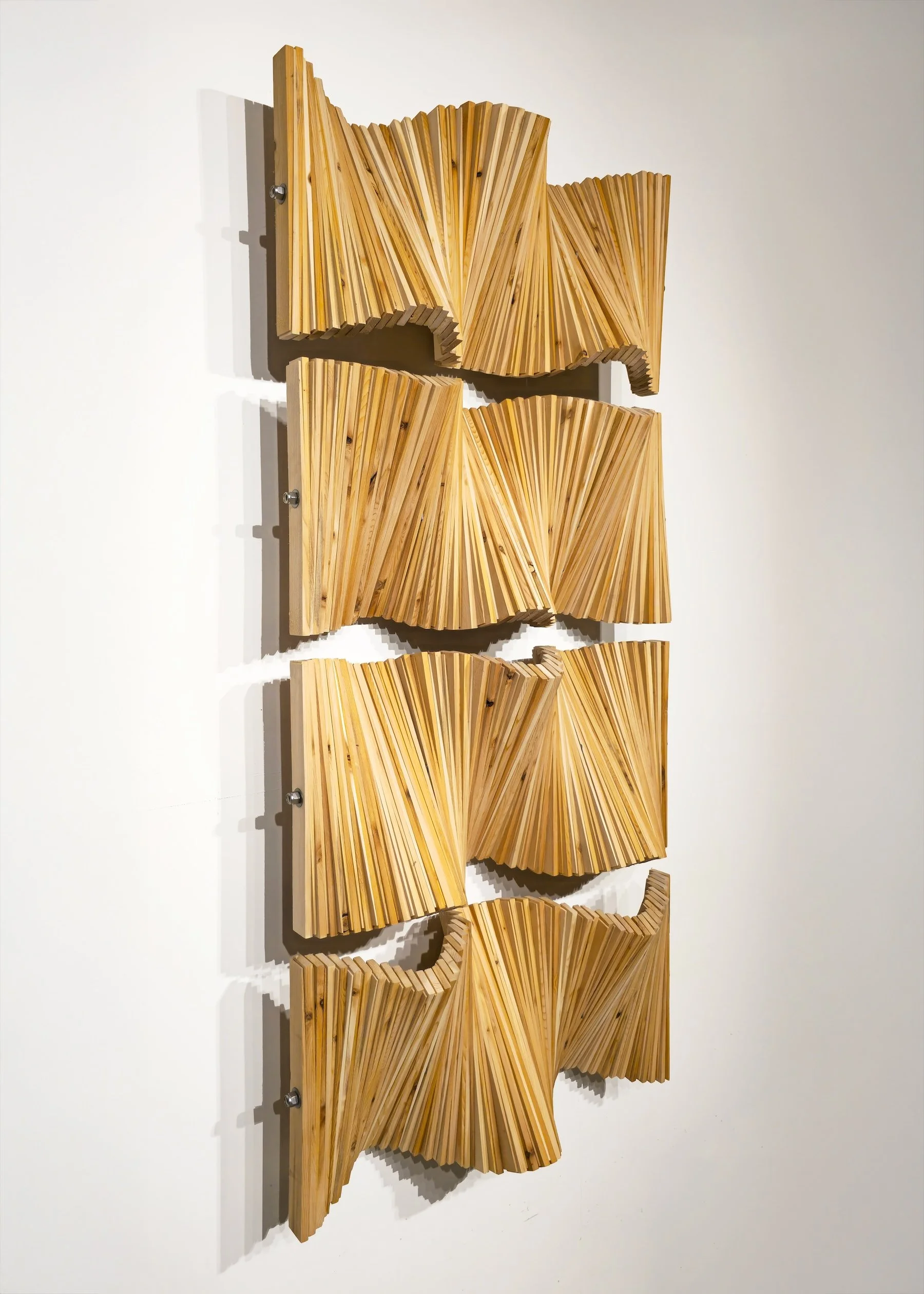
N: When shaping these forms, I aim to evoke energy and fluidity, even with rigid materials. I’m often inspired by nature in my practice—the movement of water or the way light dances—leading me to explore how these materials can mimic the organic qualities of motion. I consider how the viewer’s perspective changes as they move around the piece, creating a dialogue between the artwork and its environment that continually evolves with each shift in position.
Q: Your work is built from countless narrow strips, wooden, metal, or fabric, creating a woven or pleated texture. What draws you to working with repetition and modular components in this way, and how do you choose these materials?
N: Working with repetition and modular components allows me to create a sense of cohesion and rhythm within my pieces. The act of layering not only creates a distinct visual texture but also symbolizes the interconnectedness of ideas and experiences. I choose materials based on their inherent qualities—like the warmth of wood, the industrial feel of metal, or the softness of fabric—and consider how each will contribute to the work's overall narrative. This selection process is intuitive, guided by how the materials resonate with the themes I’m exploring in my practice.
Q: As a wall piece that shifts with light and shadow, how do you imagine it changing the atmosphere of a home or space over the course of a day?
N: Light and shadow are active elements in my work and are always considered when I create new pieces. As light changes throughout the day, the artwork's shadows and reflections will shift, creating an ever-changing atmosphere. In the morning, there might be a soft, gentle glow; in the afternoon, sharper contrasts; and in the evening, warm, deeper tones. This interplay between light and shadow invites viewers to re-engage with the artwork over time, making it a living part of the space that adds depth and dimension.
Q: Could you talk about how the wave-like undulations were planned or formed? Was it a mathematical, intuitive, or more experimental process?
N: The creation of the wave-like undulations is a blend of intuition and experimentation. The individual elements in these installations are created mathematically, but I allow myself the freedom to experiment during the installation phase. As I work with the materials, I respond to their unique properties, letting them inform the final shape. While I may have a vision, there is also a significant degree of spontaneity involved. The interaction between intention and discovery is a crucial part of my creative process, allowing the wave-like undulations to feel both structured and alive.
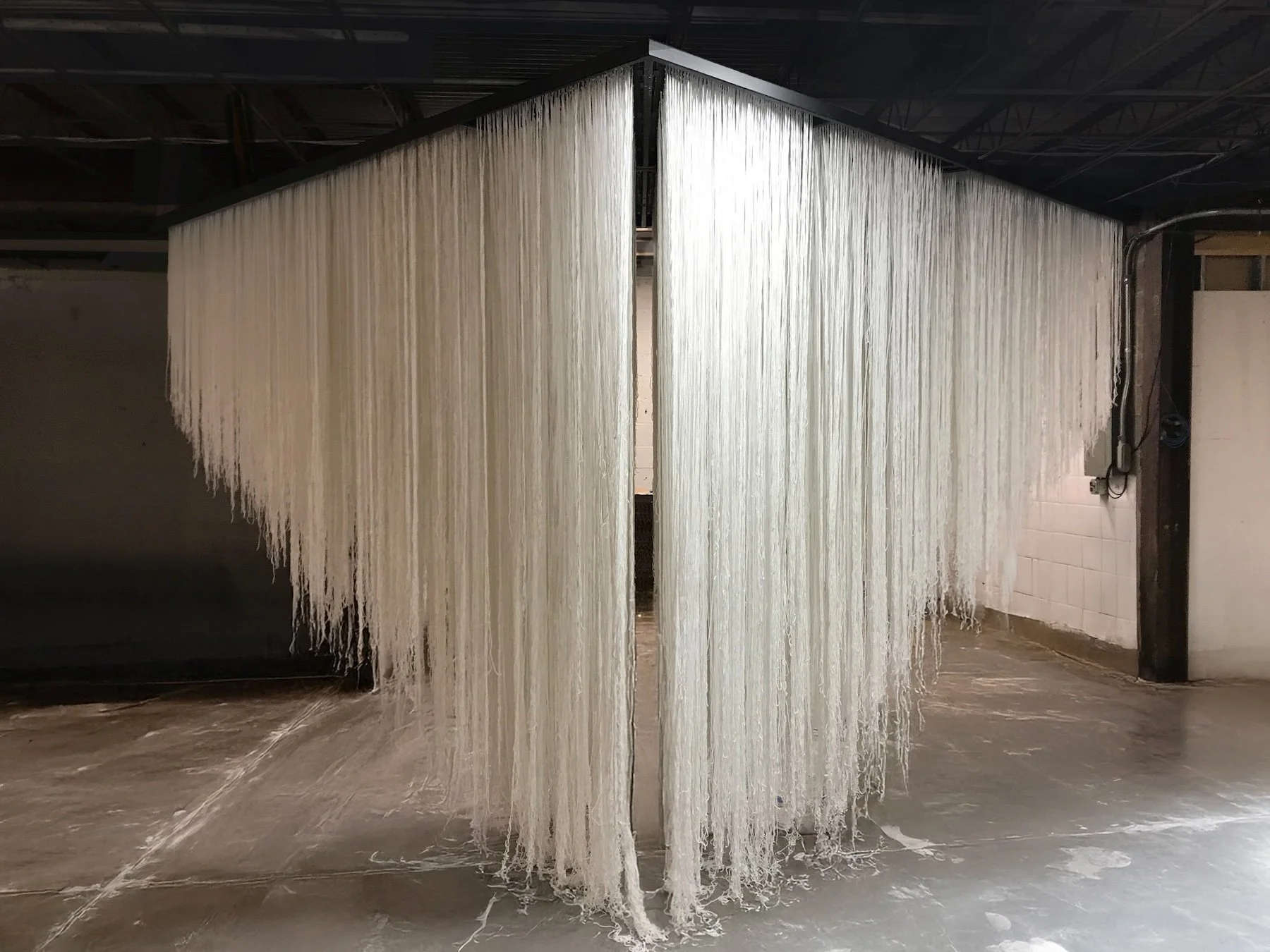
Q: The dimensionality invites the viewer to engage with the work physically, walking around it, noticing edges and valleys. How important is this embodied interaction to your practice?
N: Embodied interaction is fundamental to my practice. I want my work not only to be observed but also to be experienced. By inviting people to walk around the piece, I encourage them to explore the nuances of its shapes and textures that may not be immediately apparent from a single viewpoint. The interplay of edges and valleys creates a tactile landscape that draws the viewer in, prompting movement and the discovery of new perspectives. The experience of interacting with the piece becomes as significant as the artwork itself, fostering a deeper relationship between the viewer and the work.
Q: As you continue working with sculptural surfaces, what aspects, like scale, pattern, movement, or modularity, are you excited to push further?
N: I am particularly excited to explore the interplay between scale and pattern in my future installations. Most of my work is envisioned at a much larger scale on paper than what I can create in reality due to space and budget limitations. My framed works act as texture swatches—polished samples that I imagine crawling along walls or draping from ceilings. By experimenting with larger scales, I aim to create immersive experiences that envelop the viewer and foster a dynamic dialogue between the artwork and its environment.